Trusted by 35,000+ enterprises across 36 countries and regions worldwide







Trusted by 35,000+ enterprises across 36 countries and regions worldwide
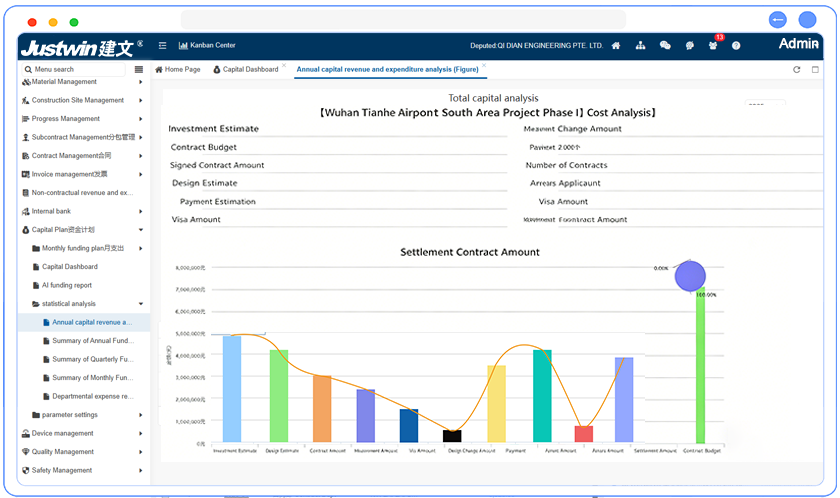
Estimate and budget management covers investment estimation, contract planning, design budget and winning bid budget. Conduct scientific cost planning throughout the whole process from project initiation to contract signing, providing accurate upper limits and control basis for project investment.
Focusing on bidding, procurement, contract, construction and completion stages, digital management ensures no cost overrun against budget, realizing efficient capital utilization and transparent & compliant expenditure.
Track cost changes in real time, collect and analyze actual costs in multiple dimensions, accurately locate deviation sources, and provide reliable data support for cost optimization.
Adopt five-dimension comparison, quantity & price variance analysis and management fee analysis to track full-cycle cost dynamics, explore root causes of deviations, and support cost control and decision optimization for subsequent projects.
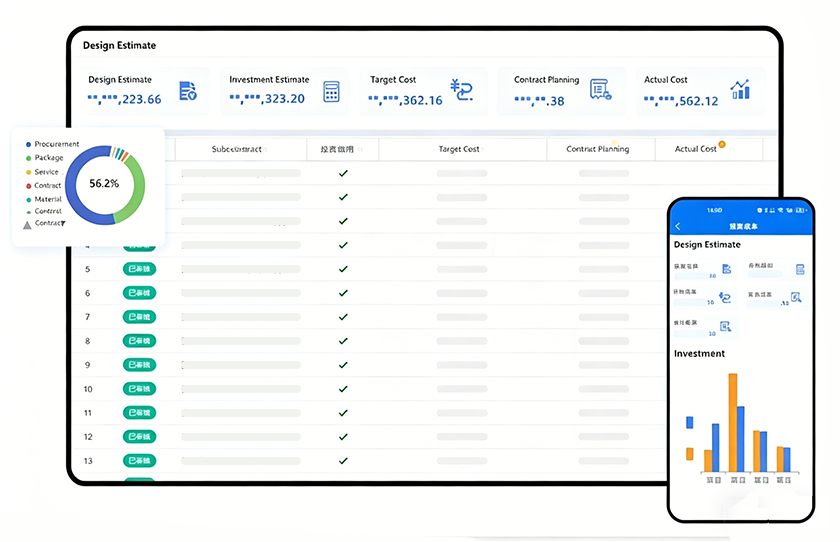
Investment Estimation: Closely linked with the feasibility study module at the project approval stage, helping quickly generate standard total investment estimation, supporting multi-version comparison and risk assessment, providing accurate data for feasibility research and assisting owners in setting scientific investment ceilings.
Contract Planning: Seamlessly integrated with the bidding management module, effectively arranging contract packages, clarifying contract scope, professional division and bidding strategies, serving as the basis of bidding plans and associating with cost accounts.
Design Budget: Support online import and compilation of design budget documents. AI deviation analysis verifies whether design results exceed investment estimation, optimizing quota design to control overall costs.
Contract Budget: Automatically solidify contract budget based on bidding documents, deeply integrated with contract management. It acts as the benchmark for progress payment, change visa and final settlement. Combined with AI cost early warning, it monitors budget execution in real time to ensure strict cost control.
Free Trial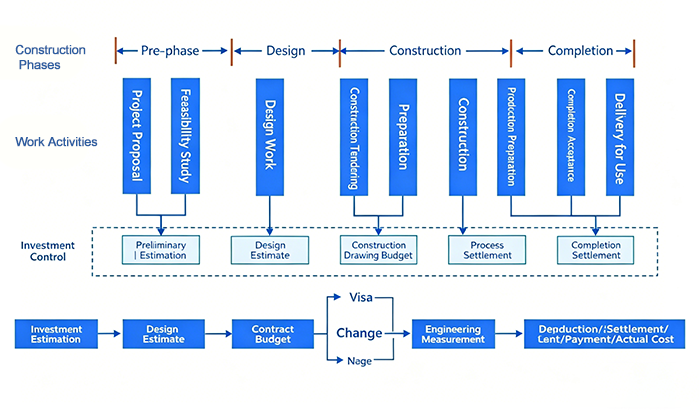
Bidding & Procurement Stage: AI analyzes bidding documents in real time, compares contract planning boundaries to prevent budget overrun, realizing boundary early warning and full-process traceability.
Contract Stage: Build a multi-level account system, dynamically associate with design budget, automatically generate bidding control prices and lock the upper limit of contract amount to ensure contract planning does not exceed target cost.
Construction Stage: Centered on engineering measurement, collect costs based on WBS structure, dynamically track progress payment and final settlement, and display cost deviation ratio in real time to ensure compliant and transparent expenditure.
Completion Stage: Compare final settlement documents with visas & design changes, cooperate with settlement audit to verify final costs and ensure settlement data accuracy.
Cost Early Warning: Set multi-level warning thresholds based on budget and actual cost data. Automatic reminders will be pushed to responsible persons once deviations occur, promoting timely correction.
Free Trial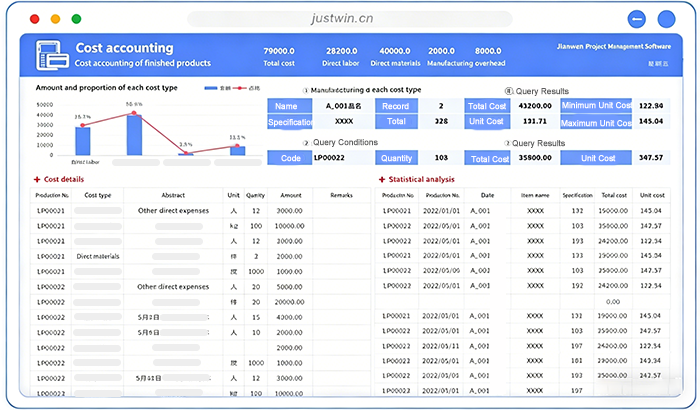
Cost Change: Track cost changes caused by design modification, contract adjustment and site visas in real time. Standard approval procedures control the rationality of changes, ensuring all cost adjustments are fully documented and avoiding cost risks.
Cost Accounting: Gather actual costs from project, account and BOQ dimensions. Multi-dimensional data drilling analysis accurately locates cost deviations and provides data support for cost optimization.
Deviation Tracing: Quickly identify excessive or saved cost links and causes through multi-dimensional analysis including project, account, BOQ and date.
Dynamic Tracking: Update cost data in real time combined with engineering measurement and construction progress, ensuring synchronization between accounting and actual expenditure.
Free Trial
Five-Dimension Comparison: Compare design budget, contract budget, target cost, actual cost and final settlement data, track full-cycle cost changes, explore deviation causes, and accumulate experience for future project cost control.
Quantity Variance Analysis: Compare budget quantity with actual consumption of engineering quantities and supplied materials, analyzing reasons for over-consumption or savings such as construction errors and design changes.
Price Variance Analysis: Identify the impact of price fluctuations by comparing bidding prices, market prices and actual purchase prices, so as to reduce procurement costs and improve project profits.
Management Fee Analysis: Monitor indirect cost compliance by comparing budgeted and actual administrative expenses, analyzing overspending reasons such as personnel efficiency and expense control, and optimizing management processes to reduce non-production costs.
Free TrialSupport direct import of BOQ, quota and unit price files from mainstream cost software such as Glodon, Luban and Siweier. Provide standard Excel/CSV templates and mapping guides for projects, branches, BOQ items and resource codes.
Custom API & Web Service interfaces are available for two-way data synchronization, including material prices, quota database and BOQ rules.
Support budget locking and version management with difference marking. Enterprise quota database matching and price linkage ensure unified standards and full traceability.
Yes. If contract planning is not prepared, the system will associate bidding, procurement and contracts directly with design budget or target cost. Automatic early warning and approval interception will be triggered for over-budget expenses.
Support virtual contract and budget account mapping to standardize non-contract expenses such as provisional sums and emergency costs, realizing multi-level review and overall cost summary.
Establish coding mapping between budget, contract and payment to achieve "total budget control, contract control and payment control".
The system establishes one-to-one mapping between budget codes, BOQ codes and contract line items. Bidding control price, procurement list and contract list all follow budget standards.
Budget occupancy inspection will be conducted in the bidding phase. Strict control or special approval is required for over-budget items. All payments and changes will reverse update budget occupancy after contract signing.
Support direct budget connection in the early stage and smooth data migration after contract planning launch.
Cost changes are summarized uniformly in final settlement by default. Meanwhile, instant association and rolling inclusion in interim measurement & settlement are available upon project configuration.
Change impact evaluation and re-warning mechanism: Once changes affect budget or target cost, notifications will be pushed immediately with corrective tasks generated.
Establish change ledgers and version chains for visas & design modifications, realizing one-to-one correspondence with measurement and settlement for audit traceability.
The system automatically classifies contract items and extra-contract items from visas & design changes, verifying abnormal entries and triggering audit early warning.
Output audit comparison reports including internal & external contract amounts, increase/decrease ratio, supporting documents, approval chain and time stamp, supporting one-click export and archiving.
Link with document management to associate as-built drawings, inspection reports and attachments, ensuring consistency between data and evidence.
Support five-dimension cost comparison: design budget, contract budget, target cost, actual cost and final settlement. Multi-dimensional drilling by WBS, BOQ, cost account and contract is available.
Four major deviation indicators:
Budget Remaining / Target Surplus
Budget Balance
Quantity Variance
Price Variance
Decompose deviations by account, section, contract and supplier, with threshold early warning and closed-loop correction. Provide management fee allocation and overspending analysis.